Deployment Monitoring: Checks That Run When Your Site Changes

Scheduled monitoring finds a broken deploy on its next run — which could be minutes or hours after it shipped. NorthDuty also watches for the deploy itself, and runs the full check suite as soon as your site changes, whether that change came from a release pipeline or someone hitting Publish in WordPress.

Start your 7-day trial — no credit card, free plan after.

Run every check the moment you deploy or publish — not at the next scheduled slot.

What runs when a change is detected

The same health checks and journeys NorthDuty already runs on a schedule, re-run against the version you just shipped.

A full health audit

Not the cheap uptime tier — the full pass: SSL, DNS, redirects, Core Web Vitals, broken resources, JavaScript errors, security headers, accessibility, and SEO fundamentals. A deploy is exactly when those break, and exactly what a status-code ping cannot see.

Every active user journey

Login, signup, checkout, and search flows replayed in a real browser. A release that breaks checkout is invisible to a page-level check and obvious to a journey.

Incident-ready findings

A change-triggered health finding can be opened as an incident from Status with its source, severity, title, and technical summary already filled in.

See what the deploy broke

A change-triggered run produces the same evidence as a scheduled one — the difference is when it ran.

Journey Results

The journey run your deploy triggered

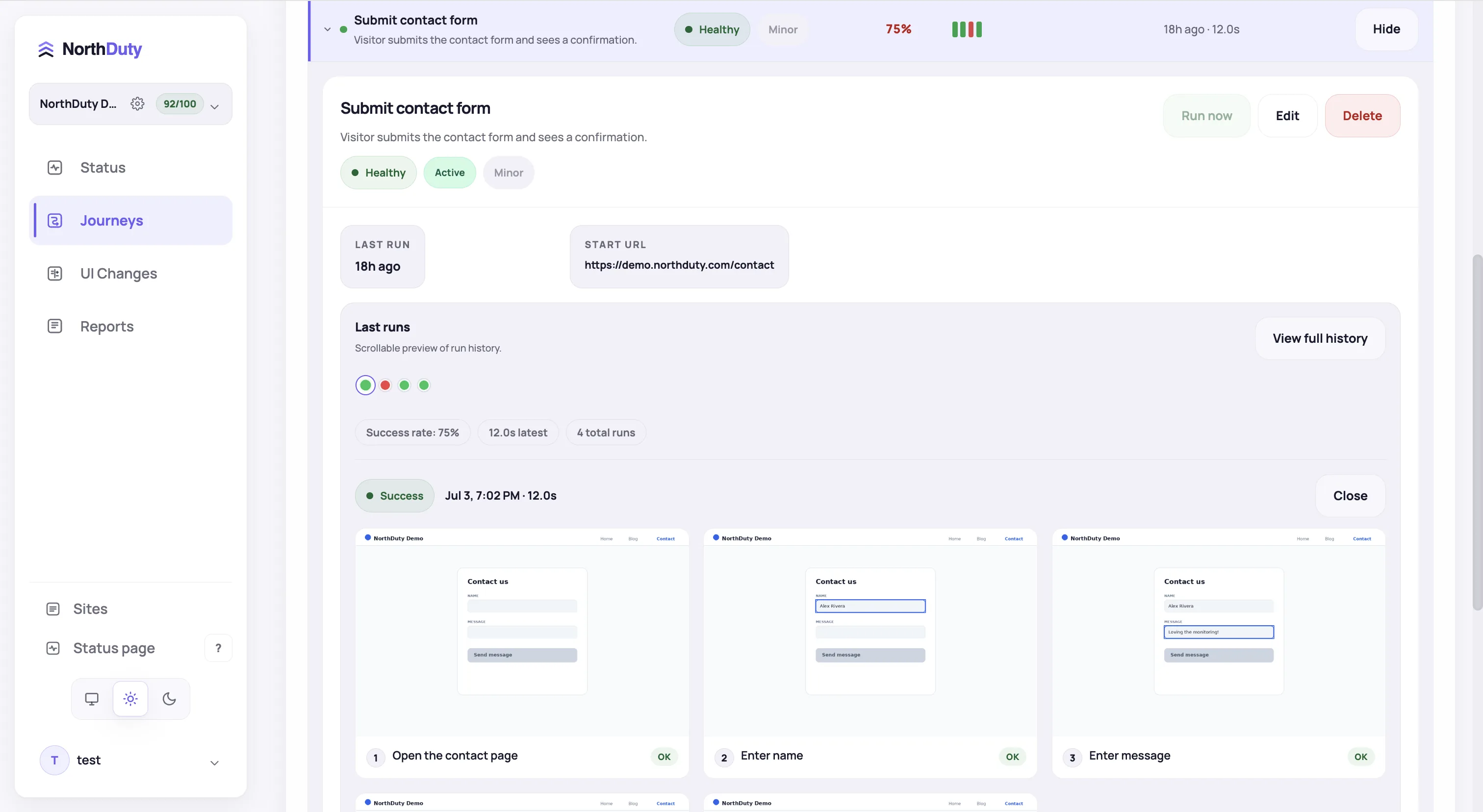
Every step the browser took, which one failed and what the page looked like — produced minutes after the release rather than at the next scheduled slot.

NorthDuty user journey monitoring detail screen showing step timeline, last runs, success rate, and step screenshots for a monitored journey.
Journey detail with step timeline, run history, step screenshots, latest duration, and success rate.

The window between shipping and finding out

Most breakages are not random — they are caused. Somebody deployed, updated a plugin, published a page, or switched a theme, and something that used to work stopped. Monitoring on a fixed timer will find it eventually, but 'eventually' is the whole problem: the gap between the change landing and the next scheduled check is the window where customers hit the broken version and you have no idea.

Deployment monitoring closes that window by making the change itself the trigger. NorthDuty detects it two ways. It watches your site for the signatures of a release — the content-hashed asset filenames every modern build tool produces, framework build IDs, CMS version bumps, sitemap and feed timestamps, and platform APIs like the WordPress REST endpoint. And it accepts a signed webhook from your CMS, host, or CI pipeline for the cases where you want it instant.

Either way the result is the same: a full health audit and every active user journey — run against the version you just shipped, not the one from an hour ago. If that run surfaces a concrete health finding, open it as an incident with the deploy context and finding details carried into response.

Why triggering on change beats waiting for the next check

Same checks, better timing — plus the context of knowing what caused the result.

How deployment monitoring works

Detect, wait for the dust to settle, then run everything once.

1

NorthDuty notices the change

Either your CMS, host, or CI posts a signed webhook, or NorthDuty's own fingerprint check spots that your asset hashes, build ID, sitemap, or CMS content timestamps moved.

2

A short settling window

One deploy can produce a dozen signals in ninety seconds. NorthDuty collapses them into a single run, and the brief wait also lets your CDN finish purging — so the capture reflects the deployed site, not a half-warm cache.

3

The full suite runs

Health audit and active user journeys — all against the new version, all producing the same reviewable evidence as a scheduled run.

4

You get told what broke — and can open the incident

Existing alert rules still notify the channels you configured. The detected finding can then move into incident management with the source and technical context already attached.

Related NorthDuty Pages

Explore pricing, feature details, solution pages, and related tools connected to this website monitoring use case.

Frequently Asked Questions

Answers to common questions about this monitoring feature and when teams should use it.

What is deployment monitoring?

Deployment monitoring runs your checks when your website changes, instead of only on a fixed timer. NorthDuty detects a deploy or a CMS publish and then runs a full health audit and your user journeys against the version that just shipped.

Do I have to install a plugin or change my pipeline?

No. NorthDuty can detect deploys from the outside by watching your site's content-hashed asset filenames, framework build ID, CMS generator version, sitemap and feed timestamps, and platform APIs such as the WordPress REST endpoint. A webhook is optional and makes detection instant rather than within the polling interval.

Which platforms does it work with?

Detection without any setup works on WordPress, Shopify, Webflow, Squarespace, Wix, Drupal, Joomla, Ghost, Magento, PrestaShop, HubSpot CMS, and any site built with Next.js, Nuxt, SvelteKit, Astro, Gatsby, Remix, Hugo, or Jekyll. Signed webhooks are supported for WordPress, Shopify, Webflow, Contentful, Sanity, Strapi, Storyblok, Prismic, Ghost, Vercel, Netlify, Cloudflare Pages, GitHub Actions, GitLab CI, and Bitbucket Pipelines — plus a generic endpoint any script can post to. On WordPress, the free NorthDuty Connect plugin sends that webhook for you.

Will a preview or staging deploy trigger a run?

No. Preview and branch deploys on platforms like Vercel and Netlify are recognised and ignored, as are failed builds, in-progress builds, and CI runs on non-default branches. Only successful production releases trigger monitoring.

Will a busy publishing schedule burn through my checks?

No. Signals arriving close together are collapsed into a single run, and a minimum interval between change-triggered runs caps how often they can fire regardless of how chatty the source is. Your scheduled monitoring continues unaffected.

Does this replace scheduled monitoring?

No — it adds to it. Scheduled checks still catch problems that appear without a deploy, such as an expiring certificate, a third-party script failing, or an origin going down. Deployment monitoring covers the changes you cause.

Which plans include deployment monitoring?

Webhook-triggered checks, including the free NorthDuty Connect WordPress plugin, work on every plan. On Free, every change gets a health check and your journey re-runs on up to 3 changes a day. Automatic detection without a webhook, and journey re-runs on every change, are included on all paid plans, starting with Starter at $29 per month.
Start monitoring your website with NorthDuty today.

Stop finding out about a bad release at the next scheduled check. Let NorthDuty run the full suite the moment your site changes.

7 days with Pro features and limits, no credit card — then keep one daily journey on the free plan.